

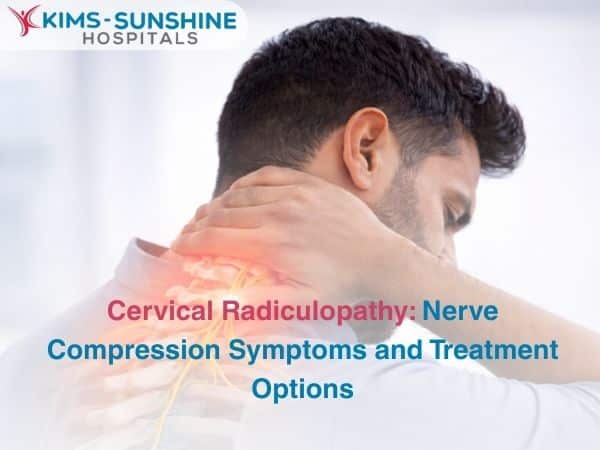
Cervical Radiculopathy: Nerve Compression Symptoms and Treatment Options

Verified By
KIMS-SUNSHINE
Specialist,
29 January, 2026
Have you ever had pain that appears in the vicinity of the shoulder, around the arms or in the fingers? Nowadays, we associate such pains with long working hours and poor posture. While that may be true for most, in some cases, it may be something else. Cervical radiculopathy may occur due to injuries or compressions at cervical spine nerve roots. The cervical nerves arise from the spinal cord in the neck and travel to the arm to provide sensory information and when they get affected, the resemblance of the symptoms to issues with the shoulder, carpal tunnel syndrome or tiredness often delays a diagnosis. With timely diagnosis and treatment of this neurological issue, you can avoid the need for surgery later on.
What Is Cervical Radiculopathy and Why Does It Occur?
Cervical radiculopathy happens due to congestion of the spinal nerve root, leading to a typical pinched nerve in the neck symptoms. A herniated disc in the neck is the leading cause of this issue. Discs that support the spinal column may swell or break open and apply pressure on nearby nerves. Trauma, spinal instability, or tumours could contribute to the same issue, but this is rare. The nerve’s regular function is disrupted by pressure no matter what the cause is. Malfunctions occur in the firing of pain signals, as well as nerve transmissions to muscles. Symptoms may occur at different sites depending on which nerve root is affected. While some patients may feel only mild discomfort, others may experience significant weakness that affects gripping or arm movement.
Symptoms and How They Progress
Symptoms of cervical radiculopathy often develop slowly. Neck pain radiating to arm- that is a typical initial sign. A lot of patients describe a sharp burning or electric shock sensation. . Experiencing numbness or tingling in fingers is entirely possible too. As someone ages, the muscle of the arm or hand weakens. It is hard to lift things, write, and do things in everyday life. When you look up or bend forward, your symptoms might become worse. Coughing and sneezing can increase back pain. In some situations, symptoms decrease with rest while in other cases, they worsen. In the absence of treatment, persistent nerve compression may lead to irreversible loss of sensation. Worsening pain, increasing weakness, or symptoms that affect everyday function can necessitate the need for a detailed medical evaluation.
Diagnosis and Treatment Options
Diagnosis starts with assessment of reflexes, muscle strength and sensation through clinical examination. Imaging like MRI is very helpful to confirm cervical nerve root compression and to identify the cause. An MRI is the best as it takes clear pictures of the discs, nerves and soft tissues. Nerve conduction studies may be performed to assess nerve function in specific cases.
Cervical radiculopathy treatment options are often conservative initially and consist of rest, changing activities, painkillers and physiotherapy to improve posture, strengthen neck muscles and ease nerve pressure. Cervical traction along with guided exercises can be very beneficial too. If conservative care doesn’t alleviate your symptoms, you may qualify for epidural steroid injections at the encroached nerve root to help reduce the inflammation. Patients with a neurological inability or progressive disability may benefit from surgery if they’re not responding to non-surgical treatment. Such procedures are best planned and performed at KIMS Sunshine, the best orthopedic hospital in Hyderabad where spine care, imaging and rehabilitation services are available under one roof.The goal of surgery is to relieve nerve compression and stabilize the spine as needed.
Conclusion
Neck and arm pain can often be attributed to a medical problem known as cervical radiculopathy. Most cases improve well with conservative treatment but early diagnosis is important to prevent irreversible nerve damage. If you notice any related radiating pain or numbness and weakness, evaluation can help a lot. Current developments in imaging, physiotherapy and increasingly less invasive surgical techniques offer almost all patients the realistic goal of achieving pain relief and a return to normal activities. Before the condition becomes complicated, consulting a spine specialist in Hyderabad or visiting our well-equipped orthopaedic hospital in Hyderabad can help ensure accurate diagnosis and timely treatment.
Frequently Asked Questions
What is cervical radiculopathy?
What causes a pinched nerve in the neck?
Can cervical radiculopathy heal without surgery?
When is surgery needed for cervical radiculopathy?
How long does recovery usually take?