

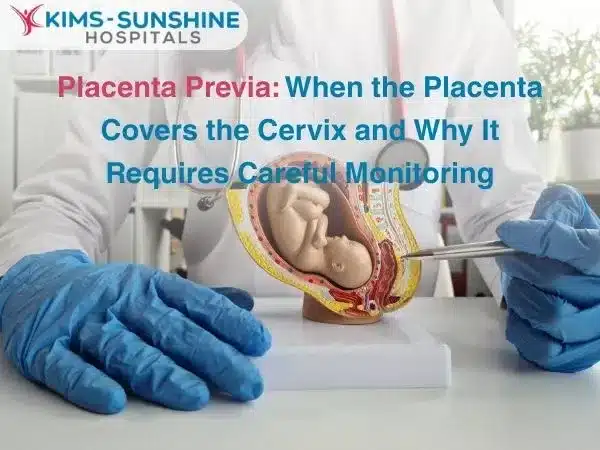
Placenta Previa: When the Placenta Covers the Cervix and Why It Requires Careful Monitoring

Verified By
KIMS-SUNSHINE
Specialist,
22 February, 2026

Placenta previa is a condition where the placenta covers the cervix either partially or fully. This is classified as a high-risk pregnancy condition and one way to prevent any complications is to go for planned C-section delivery, after consultation with an experienced gynaecologist. The placenta is an organ that helps provide nutrition for the fetus via blood that flows to and from the umbilical cord. In most women, the placenta begins its growth in the lower part of the uterus, but as the pregnancy progresses, it moves upwards, so that vaginal delivery is possible. If you notice painless bleeding in the second or third trimesters, it is time to visit a gynecologist at KIMS Sunshine- the best hospital in Hyderabad.
Symptoms of Placenta Previa
The extent of symptoms you will notice depend on how much of the cervix the placenta has covered. Closure may be partial, complete or marginal.
- In marginal previa, the placenta tends to touch the cervix, but nothing else happens. This mostly resolves by itself before childbirth for many women.
- In partial previa, the placenta partially covers the cervix.
- Complete previa means the cervix is completely covered by the placenta and this condition will mostly not resolve by itself.
Symptoms of this condition include
- Third trimester bleeding- bright red blood which comes and goes from the second trimester onwards and gets worse towards the end of pregnancy.
- Cramping may be present, though most women don’t feel them.
Complications of this condition include severe bleeding, preterm birth, anaemia due to blood loss, placenta accreta where the placenta burrows too deep in the uterine wall and hence causes more bleeding when it gets dislodged after birth or when there is abruption – where the placenta is no longer connected to the uterus, impacting nutrition and growth of the baby, respectively.
Bleeding occurs because there are uterine contractions and the cervix begins to thin out and efface, in preparation for delivery. Both of these events can cause delicate blood vessels to tear and bleed.
Diagnosis of Placenta Previa
Imaging is the main approach used to diagnose this condition-
- A transvaginal ultrasound helps in checking the position of cervix, baby and placenta, very early on in your pregnancy (before 9 weeks gestation or so).
- An abdominal ultrasound is sufficient afterwards to diagnose this condition.
Treatment For Placenta Previa
There is no treatment for this condition. The only aim is to help you get through your pregnancy without complications developing and hoping that the foetus grows enough for a planned C-section delivery to be done at term (or even before, if you bleed too much).
Some preventive maternal fetal monitoring measures you will be asked to follow include- bed rest, no strenuous activity, no sexual intercourse or tampon usage and to go in for follow up appointments more often. But these work only if you have marginal placenta previa. For partial or complete previa with bleeding, complete bedrest is recommended.
You can get blood transfusions if bleeding is severe and emergency C-section will be done, if bleeding remains uncontrollable.
Your baby may be born earlier than the due date or a vaginal delivery may not be possible, as you could bleed uncontrollably. Your doctor will be able to come to a conclusion based on your symptoms, growth of the baby and how close you are to the due date, among other factors.
Conclusion
Placenta previa could cause complications for the mother and the baby before, during and after birth. Hence, talk to a specialist and go to your prenatal appointments on schedule, without skipping any of them. A vaginal delivery is normally not recommended as the risk of you bleeding too much is very high.Your baby may be born earlier or later but don’t worry too much. Focus on eating well, getting enough rest and listen to your gynaecologist- as they are trained to make sure that both you and the baby get through childbirth as a process, unscathed. So, get ready to hold your little bundle of joy soon and call us for a consultation today!
Frequently Asked Questions
What is placenta previa?
What causes placenta previa?
Why does it cause painless bleeding?
Can placenta previa resolve on its own?
When is a C-section required?