


Pancreatic Cancer: Why It’s Often Detected Late and What Symptoms to Watch For

Verified By
KIMS-SUNSHINE
Specialist,
13 June, 2026
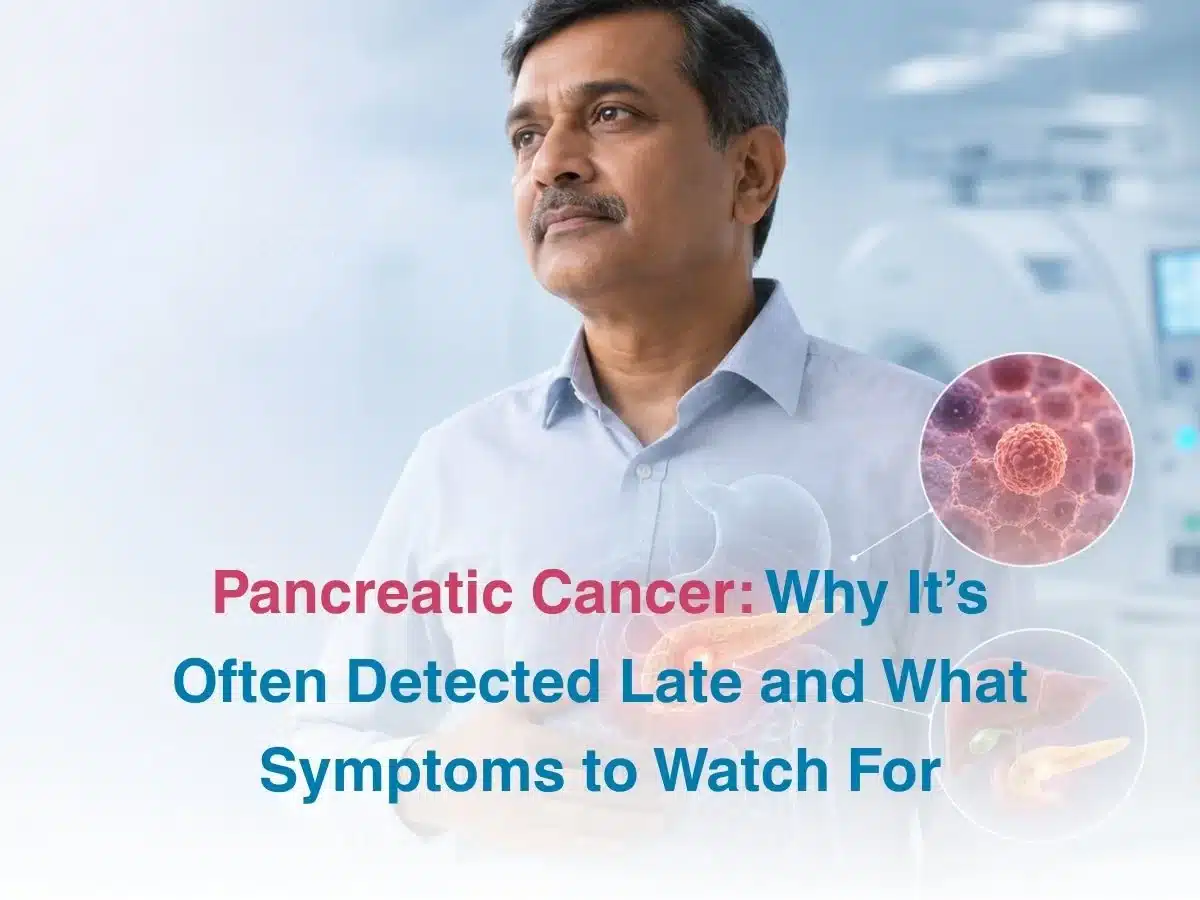
The pancreas is a crucial organ that makes insulin, glucagon, lipases, proteases and other proteins- so it can be thought of as a digestive powerhouse that makes exocrine and endocrine hormones.Many early signs of pancreatic cancer are very easy to ignore, as they mimic other benign conditions. When pancreatic cancer symptoms do show up, it is already very late and aggressive treatment may also not suffice to deal with it.
You will need to talk to a gastro oncology specialist at KIMS Sunshine Hospital without any delay, if you observe any of the early signs or symptoms, which have been explained in detail!
Causes of Pancreatic Cancer-
Many studies have managed to zero in on the genetic mutations that cause pancreatic cells to become cancerous- majority of the cases involve issues with the KRAS gene, which develops with advancing age, in a spontaneous manner.
Symptoms of Pancreatic Cancer-
There are no early signs of pancreatic cancer to know of, unfortunately, that can help you identify the condition and get help soon. When the following symptoms do show up, the cancer has already advanced to a level which may be hard to deal with-
- Abdominal pain – upper, mid-back or the flank can get affected.
- The liver also gets affected- and you may look jaundiced.
- You may feel nauseous very often.
- You may not feel like eating anything, leading to unintended weight loss.
- You may either be constipated or have diarrhoea.
- You may feel very tired all the time.
- If you have recently had issues or symptoms of pancreatitis or diabetes develop, then doctors may suspect pancreatic cancer.
Please opt for pancreatic cancer screening tests at KIMS Sunshine Hospital if there is a family history of pancreatic cancer, or if you have underlying conditions.
Diagnosis of Pancreatic Cancer-
Getting a pancreatic tumor diagnosis quickly can be hard as the organ is located deep within the abdomen and is hard to palpate or feel for any anomalies. Doctors instead need to rely on a battery of tests to confirm this condition-
- Blood tests– To check for specific biomarkers like (CA) 19-9 or carbohydrate antigen 19-9 which indicate the presence of cancerous cells. High values show the presence of a tumor, while this test can also be used to check if you are in remission after treatment.
- Imaging– PET, CT or ultrasound scans can be used to check for tumors. An endoscopic ultrasound is a specialised test for this purpose.
- A biopsy may be taken during an endoscopic ultrasound scan.
Imaging is crucial to help stage the tumor- as in, ascertain the stage of the pancreatic cancer. These are the possible stages-
- Resectable– The tumor is highly localised in the pancreas and can be surgically resected or removed. (Stage 1)
- Borderline resectable– Still removable but not as localised and may involve a few blood vessels too. Known as Stage 2.
- Locally advanced- many blood vessels are involved along with pancreatic tissue, making surgery impossible. Called Stage 3 cancer.
- Metastatic– The cancer cells have spread to other organs in the abdomen and lungs and this is the hardest to treat. Stage 4.
Treatment of Pancreatic Cancer-
Surgery is the best way if the tumor can be removed, so get a pancreatic surgery consultation immediately, after diagnosis. Other methods of treatment don’t work as well as surgical resection of the tumor. These are the options-
- Whipple procedure- The widest part of the pancreas, some lymph nodes, initial part of the small intestine, some parts of the bile duct and the whole gallbladder are surgically removed.
- Distal pancreatectomy- The spleen and the thinnest or farthest part of the pancreas is surgically removed if the tumor is localised to that area.
- Total pancreatectomy- The whole of the pancreas, gallbladder, spleen and some parts of the small intestine and stomach are removed.
You will need insulin injections and enzymes to help you digest food afterwards as you will be diabetic for life.
Other pancreatic cancer treatment options include chemotherapy, radiation therapy and targeted therapy. But, such drugs don’t really work on the pancreas often, as they cannot even access the organ in many cases and gain entry to be effective.
Conclusion
Some well known risk factors include drinking or smoking often, being obese, suffering from Type 2 diabetes mellitus, pancreatitis etc. So, please call us for abdominal pain cancer evaluation, as we are the best cancer hospital for pancreatic cancer in the state. Talk to us today!