

Zenker’s Diverticulum: A Rare Swallowing Disorder Causing Regurgitation and Cough

Verified By
KIMS-SUNSHINE
Specialist,
04 April, 2026
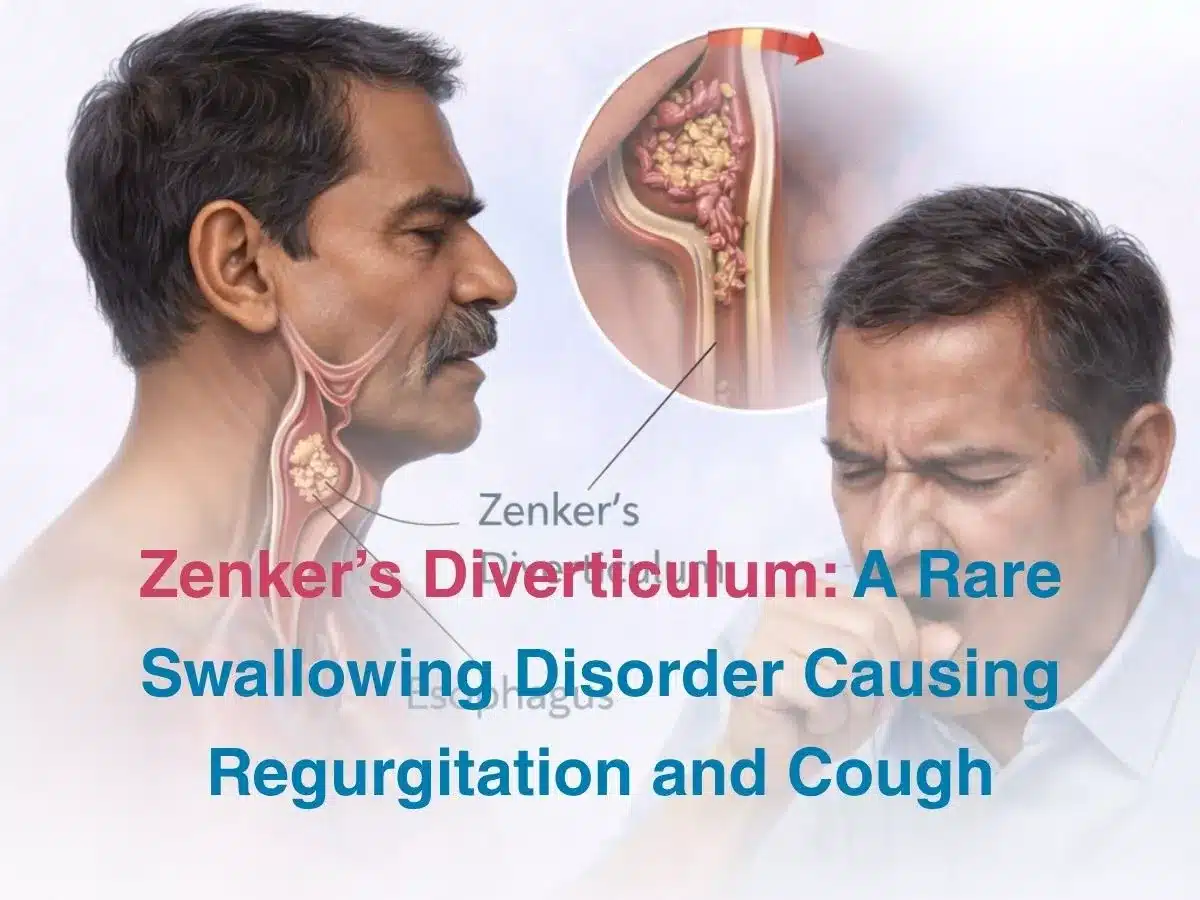
The oesophagus is an essential organ that helps food and drink move down to the stomach, from the mouth, using peristaltic movements, that are regulated by contracting muscles. Some individuals may develop a pouch or diverticulum that shoots off the food pipe. The pouch is actually formed by the malfunctioning upper sphincter muscle of the oesophagus. This can make it hard for them to swallow anything and cause related issues. If you have major difficulty swallowing solids or a chronic cough after eating, among other symptoms, then don’t hesitate to call us at KIMS Sunshine Hospital- as we are the best gastroenterology hospital in Hyderabad.
Causes for Zenker’s Diverticulum
The main reason for this condition to occur is a malfunctioning cricopharyngeus or upper esophageal sphincter muscle. It normally squeezes against the upper esophageal muscle, so the food pipe remains closed most of the time and relaxes when something needs to be swallowed. When this relaxation does not happen properly, the food pipe does not stay open for long.
While this is happening, peristalsis of muscle further down is still working to push food down to the stomach. When both these forces come into play together, there is too much pressure at the walls of the throat. This causes a pouch to form, at the weak spot. Doctors however, still don’t know why the upper sphincter muscle does not work properly in such cases.
Zenker’s Diverticulum Symptoms
These are some pronounced symptoms that you will notice, if you suffer from this condition-
- You may have difficulty swallowing solids- as food gets stuck in the pouch and gets pushed right back to the throat. This can lead to regurgitation of undigested food.
- Some food may enter the wrong place- the windpipe and lead to aspiration pneumonia in a few cases.
- You may have a chronic cough after eating – since you may try to clear your airway.
- Halitosis– The food that does remain in the pouch causes bad breath due to food retention and subsequent decay.
- A globus sensation- where you feel there is a lump in your throat.
- Dysphonia– your voice may become very hoarse, if the pouch presses on the nerve that controls the voice box and pharynx.
- Weight loss– Since you may eat less than before, you may lose weight too.
The main complications of this condition include you suffering from severe aspiration pneumonia or becoming malnourished over time.
Diagnosis and Treatment of Zenker’s Diverticulum
This condition is diagnosed with imaging for confirmation, after a detailed medical history is taken.
- An esophagram is done- which is the barium swallow test. A solution laced with barium is used. After consumption, the food pipe and surrounding areas are systematically imaged. This is to see how the muscles in the food pipe work, when you swallow any substance.
- An esophageal manometry is recommended when doctors want to learn how the esophagus is working.
- An upper endoscopy is done where a tube with a camera at one end is inserted down the throat and into the food pipe- to check for structural abnormalities.
Treatment is normally done using surgery, if you have serious issues with swallowing or recurrent infections like aspiration pneumonia. Otherwise, doctors will try to manage your symptoms by asking you to change how you eat food and eat softer foods on a regular basis. Some surgical treatments include-
- An endoscopic diverticulotomy– where the septum or wall between the pouch and the food pipe is removed, so that it is easier for you to swallow. This is simple and an outpatient procedure where you recover quickly. Hence, an endoscopy is used for diagnosis and treatment in such cases.
- ZPOEM– Cuts are made to the upper esophageal sphincter muscle, so that it stretches. It is a type of myotomy.
- Open surgery is also an option for more severe cases, though recovery will take much longer.
Conclusion
You will need to stay in the hospital for a few days after the surgery and eat mushy and soft foods for 2 weeks or longer. You will need to monitor for infections or injury to the lips, tongue, gums or teeth too. If your symptoms are mild, you can avoid seeds, foods with skin or hard stuff and drink water between each bite.
Frequently Asked Questions
What is Zenker’s diverticulum?
What are the symptoms of Zenker’s diverticulum?
How is Zenker’s diverticulum diagnosed?
Is surgery required for Zenker’s diverticulum?
Is Zenker’s diverticulum common in older adults?