

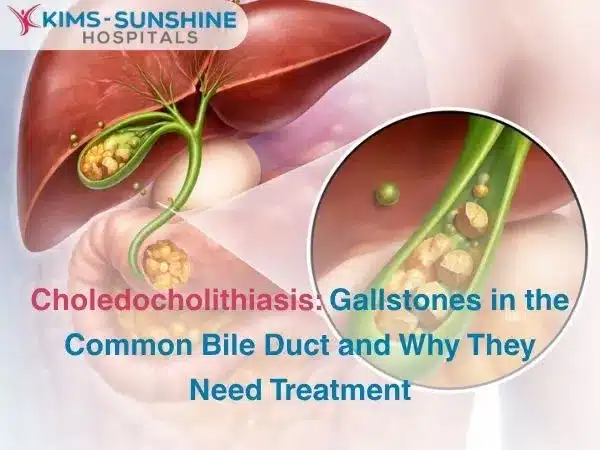
Choledocholithiasis: Gallstones in the Common Bile Duct and Why They Need Treatment

Verified By
KIMS-SUNSHINE
Specialist,
29 March, 2026
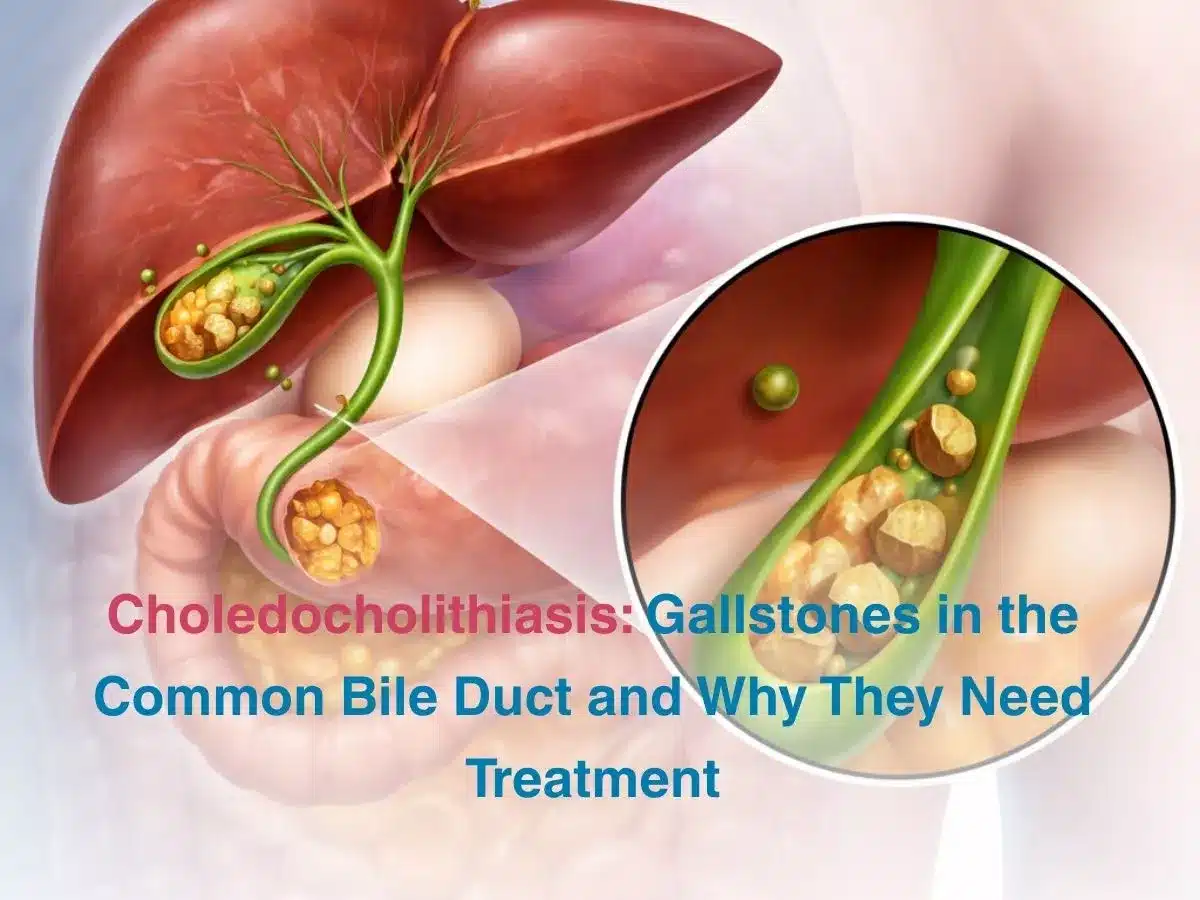
Choledocholithiasis is a condition where one or many gallstones block the common bile duct, which is the passage that allows bile to move into the intestine from the gallbladder, and when this gets blocked, food does not get digested properly. It can affect how the liver and pancreas function too. If common bile duct stones are not diagnosed and treated quickly, it can become life threatening. So, if you have severe abdominal pain, jaundice, nausea and other symptoms, call a specialist at KIMS Sunshine Hospital- as we are the best gastroenterology hospital in Hyderabad.
Choledocholithiasis Causes and Risk Factors
Common bile duct stones can form anywhere in the passages where bile flows through- it is basically crystallised crystal like pieces of bile itself. Bile is made in the liver using a combination of materials filtered from blood- like cholesterol, bile salts, lecithin, bilirubin etc. If there is too much of any one component, gallstones can form. In fact, if you have hypercholesterolemia, you are at risk of having gallstones.
When gallstones form in the gallbladder and move down into the common bile duct, it can cause the free flow of bile to stop – the bile is forced to flow back into the gallbladder, liver and pancreas as they are all connected and this can cause severe inflammation, provides a ground for pathogens to breed in and lead to complications.
Choledocholithiasis Symptoms
The hallmark symptoms of this condition include abdominal pain and jaundice. Let us look at the symptoms in greater detail below
- Severe abdominal pain- it comes in episodes- where intensity increases and decreases. It is mostly felt acutely in the upper right part of the abdomen.
- You may feel colicky and nauseous- you may either vomit often or feel like you have no appetite.
- Jaundice due to gallstones is a very common symptom- where the skin, sclera and nails turn a yellowing tinge. Urine may look dark yellow and you may have jaundice on and off too, at times.
- If there is an infection, then you may have a fever too.
Call our specialist today!
Diagnosis and Treatment Of Choledocholithiasis
Your doctor will not suspect gallstones unless you show some or all of the abovementioned symptoms. These are the main tests used to diagnose choledocholithiasis-
- Blood tests– A complete blood count, liver function, pancreatic function and bilirubin tests respectively.
- Imaging– Abdominal ultrasound, MRCP, ERCP stone removal or an endoscopic ultrasound- any of these can be used.
- Abdominal Ultrasound -It uses high frequency sound waves sent by a wand to check for how bile is flowing and other structural abnormalities.
- Endoscopic ultrasound– An upper endoscope is used to take pictures of the esophagus and upper GI tract, while an ultrasound probe can help image the liver, pancreas and biliary system in great detail.
- ERCP– Endoscopic retrograde cholangiopancreatography- this is where an endoscope is slid down the throat and into the small intestine. Then, another probe is inserted into the endoscope, which can visualise the bile ducts. A dye is injected and if it flows freely, there are no stones. If the dye does not flow properly, there is a stone blocking its path and with specialised instruments inserted through the endoscope, the stone can be removed. So, this method can diagnose and treat choledocholithiasis.
- MRCP– Magnetic resonance cholangiopancreatography is when MRI is used to image the bile ducts. This method is used if a gallstone is suspected. But, ERCP is preferred if your doctor knows for sure that a gallstone is present.
You may need antibiotics for any infection and/or biliary drainage to get rid of any bile that has backed up.
Conclusion
The most permanent way to ensure this problem does not affect you again is to surgically remove the gallbladder. This is done in a minimally invasive way, using laparoscopy. This is the only way to prevent the formation of any and all gallstones in the future. Common bile duct stones are very painful and may be life threatening if an infection is involved. So, call us for help at KIMS Sunshine hospital today!
Frequently Asked Questions
What is choledocholithiasis?
What are the symptoms of choledocholithiasis?
How is choledocholithiasis diagnosed?
Can gallstones in the bile duct cause pancreatitis?
When should someone seek urgent medical care for bile duct stones?