


Achalasia: When Swallowing Becomes Difficult and Food Gets Stuck

Verified By
KIMS-SUNSHINE
Specialist,
07 June, 2026
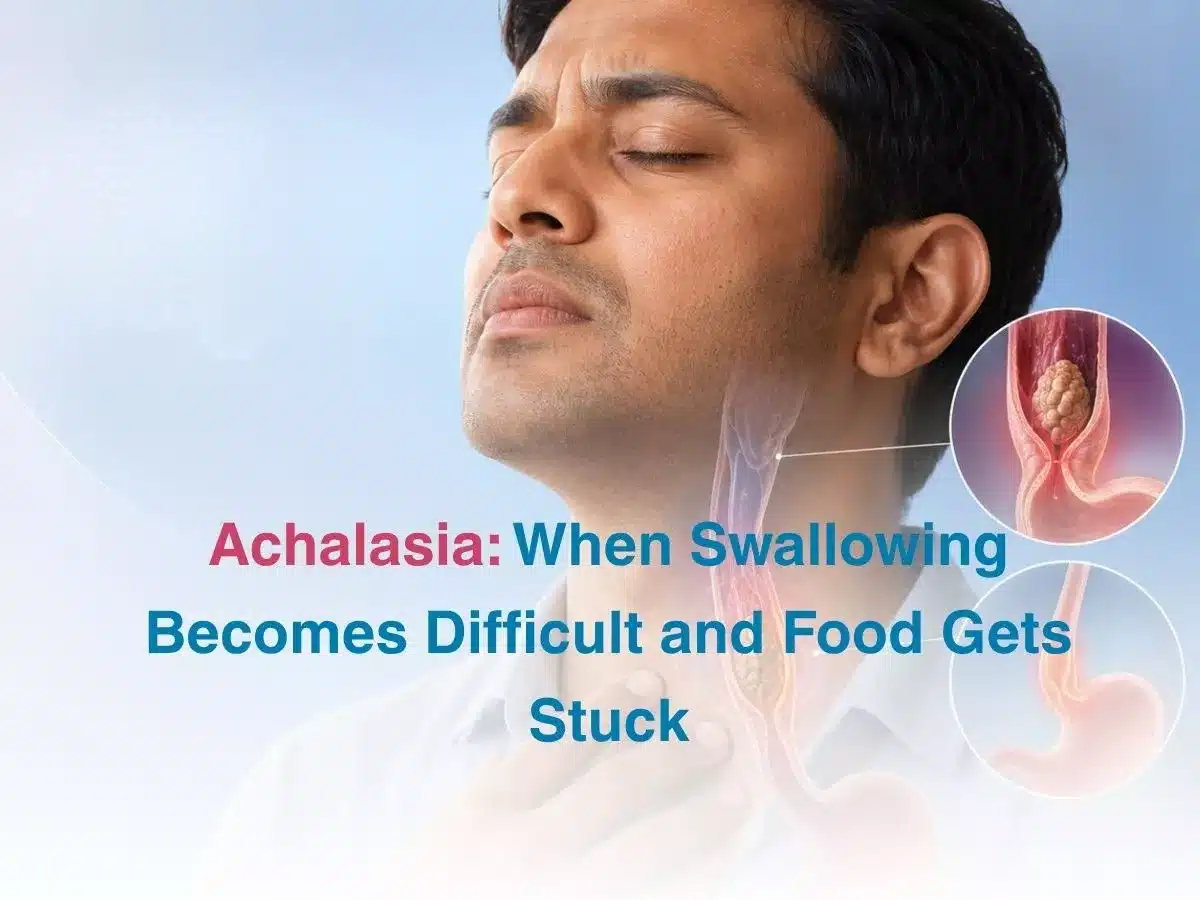
Achalasia cardia is a rare condition that makes it difficult for you to swallow anything. The muscles in the esophagus or food pipe don’t contract or relax in the right way, to push food down to the stomach. This also means that food may instead wrongly enter the lungs instead – causing unwanted complications like aspiration pneumonia too. You should consult an experienced gastroenterologist for swallowing problems at the best multispecialty hospital in Hyderabad– KIMS Sunshine.
Causes of Achalasia
Research has found that there may be an autoimmune component to this esophageal motility disorder- the immune cells attack the nerve cells in the food pipe, causing the muscles to not receive the right information from the brain- for food to move downwards. The muscles stay contracted and don’t relax enough, leading to other issues if not diagnosed and treated in time.
Symptoms of Achalasia
Since this condition develops over many years and is chronic, these are the symptoms you need to be aware of-
- You may not be able to swallow food or drink easily.
- You may have a globus sensation- like something is blocking your throat.
- You may have to deal with heartburn and regurgitation
- Chest pain may be present- it may be severe or mild.
- You may not be able to belch.
- You may have hiccups.
- You may begin to lose weight, because you may start eating less than before.
Please contact a swallowingdisorder specialist at KIMS Sunshine Hospital if you face any of these symptoms, as it can slowly affect your quality of life eventually!
Diagnosis of Achalasia
Doctors normally ask you to give them a detailed medical history – where they will ask you about your symptoms, their severity and how long you have had to deal with them. Getting a difficulty swallowing diagnosis is done using the following tests-
- Esophageal manometry test- The amount of pressure exerted by the muscles in the food pipe is measured in this test. The test hence checks how peristaltic movements occur and how the sphincter or valve-like muscles open and close at the top and bottom of the esophagus.
- Barium swallow test- This imaging test will require you to drink a solution that contains barium. A series of x-rays of your food pipe are taken when you swallow, to check how the solution moves. Since it contains barium, it shows up brightly during a fluoroscopy x-ray test. This test can allow the doctor to check for any strictures or narrowing of the food pipe.
- Upper endoscopy– A long, thin tube containing a camera on one end is inserted into the esophagus and stomach and is normally done to check for any issues like persistent regurgitation, heartburn, issues with swallowing or keeping food down etc. among others. Doctors can also insert specialised instruments to take samples, make cuts or incisions to muscles – so they relax and stop causing the food pipe to narrow down.
- Blood tests may be done to rule out other conditions which may show the same symptoms as achalasia.
Treatment of Achalasia
Achalasia treatment options include non-surgical and surgical options to help manage your symptoms. The symptoms may come back later on, which means there is no permanent cure for this condition. Let us look at the non-surgical approaches used
- Botox injections- these can help your muscles relax permanently, for a few months at a time, until its effects wear off.
- Balloon dilation- A balloon is inserted and then inflated slowly, after you are sedated. This treatment takes a few weeks, with the doctor inflating the balloon a little more and making it bigger gradually. The muscles of the esophagus slowly begin to relax.
If these approaches don’t offer much relief, you may need minimally invasive achalasia treatment-
- Laparoscopic Heller Myotomy – An endoscope is first inserted, then instruments are sent in to make cuts to the muscle fibres, to force them to relax.
- Achalasia surgery and POEM procedure – Peroral endoscopic myotomy- the muscles in the side of the esophagus, the sphincter and upper part of the stomach are all cut, which will normally take care of your symptoms for a long time.
Conclusion
Achalasia can slowly affect you by making it hard for you to eat your favorite foods. You may try to compensate by eating less, eating slowly and drinking a lot of water. But if this continues for a long time, you are at risk of developing nutritional deficiencies.
Call us for help with a long term management plan- where we will help you with tips to deal with your symptoms.
Frequently Asked Questions
When should difficulty swallowing be evaluated by a specialist?/summary>
Which specialist treats achalasia and swallowing disorders?
What tests are used to diagnose achalasia?
Is the POEM procedure effective for achalasia treatment?
How long does recovery take after achalasia treatment?