


Behçet’s Disease: Understanding This Rare Inflammatory Disorder

Verified By
KIMS-SUNSHINE
Specialist,
05 June, 2026
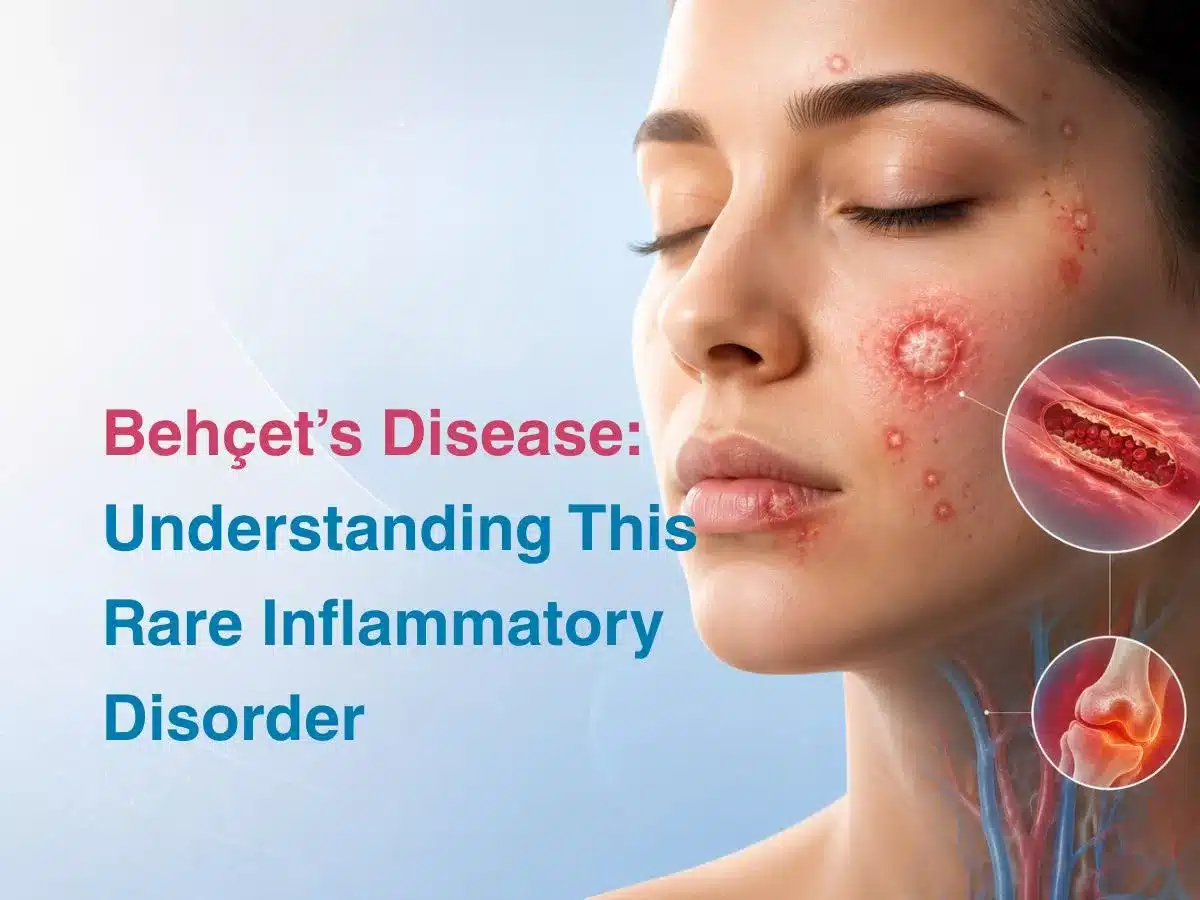
Behçet’s Disease is an autoimmune inflammatory disorder where a person may have to deal with recurrent ulcers or sores in their mouth, genital areas or even the eyes- and it is mainly a complication of untreated or poorly managed vasculitis. Also called the Silk Road disease, blood vessels are mainly targeted by the immune cells. This chronic condition is rare but not completely absent from the Indian subcontinent and affects both men and women.
You will need to talk to a specialist at the best multispecialty hospital in Hyderabad, if you notice any of the symptoms that are discussed in detail, below.
Causes of Behçet’s Disease
Scientists are not really sure about why some people have this condition while others don’t- this confusion is evident when people without the HLA-B5 and HLA-B51 also have symptoms and suffer from this condition. It is called the Silk Road disease because most of the initial cases were found in that region of the world. It is hence most prominently found to affect individuals in Turkey, Japan, Korea, Middle East and elsewhere.
Symptoms of Behçet’s Disease
These are the main symptoms that individuals observe-
- Genital/mouth sores are almost always present – these are painful and frequent. Genital sores are found on the scrotum in mena and in the vulva in women respectively.
- If you have severe joint pain – the elbows, knees, ankles and hips are affected.
- If there are ulcers or severe bouts of acne. The skin can get a red sore or bump, if it is scratched or picked at. This is actually a positive pathergy test.
- If there is eye inflammation (autoimmune disease) – blurred or double vision, tears, redness and sensitivity to light are common issues.
- Inflammation of veins and arteries, which is why a stroke is a possible complication.
- GI tract- sores can be found in the tract, similar to genital or mouth ulcers. You may not notice any symptom other than vague abdominal pain and blood in stool.
- The nerves, lungs, brain and other organs can also get affected, though their involvement is very rare.
Please consider calling a rheumatologist for Behçet’s disease at KIMS Sunshine Hospital, if you have any of the above symptoms, or a combination of them.
Diagnosis of Behçet’s Disease
A positive Behçet’s disease diagnosis is obtained after the doctor ascertains how often oral or genital ulcers come back in a year (more than 3 times), if you complain of eye and skin inflammation and there is a positive pathergy test.
A blood test is definitely needed to rule out other autoimmune conditions and different forms of vasculitis.
Treatment Of Behçet’s Disease
This is a chronic condition that needs to be managed over a lifetime, so doctors recommend –
- Drugs like corticosteroids to suppress the immune system.
- Colchicine to help with joint pain and the oral and genital sores.
- Immunosuppressants like methotrexate, cyclosporine, azathioprine, among others.
- Eye drops and medicated mouthwash can also be prescribed.
- Ointments to soothe your skin may also be given.
Conclusion
For systemic inflammatory disease management of Behçet’s disease, it is important to talk to an experienced rheumatologist. Long term management of symptoms takes precedence when it comes to taking care of yourself, after you get a positive diagnosis. So, please make it a point to stay in touch with a doctor you are comfortable with and continue treatment as prescribed or needed.
Frequently Asked Questions
When should I consult a rheumatologist for symptoms of Behçet’s disease?
Which specialist treats Behçet’s disease?
Can Behçet’s disease affect the eyes and blood vessels?
What medications are commonly used to manage Behçet’s disease?
Where can I get expert care for Behçet’s disease?